 info@valorish.eu


In VALORISH, sensory science helps researchers understand how fish-derived ingredients are perceived through taste/flavour, odour, texture and other sensory characteristics. Discover how trained sensory panels are helping turn promising ingredients into real-world food applications. Read more.
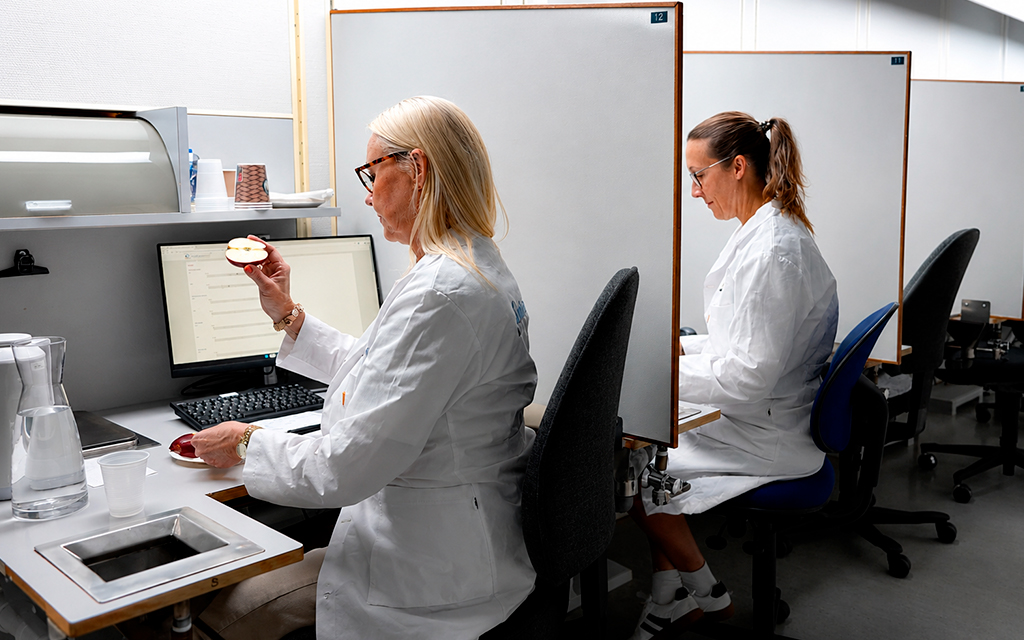
When developing a new food ingredient, demonstrating that it can be produced safely and sustainably is only part of the story. How does it smell? Does it have a bitter taste? And could these characteristics ultimately influence how and where the ingredient can be used?
These questions are particularly relevant when developing new ingredients from resources that have traditionally been considered waste or low-value by-products. In VALORISH, researchers are working to transform fish by-products into valuable resources through a circular biorefinery approach. The project targets a portfolio of products including fish oil, protein hydrolysates, collagen, vitamins, pigments, bacteriocins and calcium-rich products. Producing these ingredients is only one part of the process. Understanding their sensory characteristics is also essential.
What are the sensory properties of a product?
Sensory properties are the characteristics of a product that can be perceived through our senses. In food, these include aspects such as appearance, colour, odour, taste/flavour, texture and mouthfeel.
These properties play an important role in determining the potential applications of a food ingredient. Even when an ingredient has desirable nutritional or functional properties, characteristics such as a strong odour, bitterness or an unusual texture may influence how easily it can be incorporated into a final food product.
What is a sensory panel?
A sensory panel is a group of people who has been selected and trained to evaluate products using their senses under controlled and standardized conditions. Depending on the study, this can involve assessing characteristics related to appearance, odour, taste/flavour and texture.
Trained sensory assessors learn how to identify, describe and quantify specific sensory characteristics as objectively and consistently as possible. Trained panellists are not asked about liking or acceptance but they are rather trained and calibrated to evaluate the intensity of sensory attributes like bitterness, sweetness, fish odour, firmness or a particular aftertaste.
In this sense, trained panellists function almost like a measuring instrument — except that the instrument is the human senses.
Where are sensory panels used?
Sensory science is widely used in food research and product development.
A company changing the recipe of an existing product, for example, may want to determine whether the reformulation has created noticeable sensory differences. Researchers developing a new ingredient may need to understand how that ingredient affects the flavour, odour, appearance or texture of a final product. Sensory analysis can also be used to compare processing methods, investigate quality problems and monitor consistency during production.
Different methods can be selected depending on the research question, from determining whether two samples are perceptibly different to developing a detailed sensory profile describing the type and intensity of individual characteristics.
This becomes particularly important when working with new or alternative raw materials. An ingredient can have excellent nutritional or technological properties while still presenting sensory characteristics that make its incorporation into food products challenging.
Fish-derived ingredients are a good example. Characteristics such as odour, bitterness, astringency, aftertaste, colour or texture can influence their potential applications. Understanding these properties allows researchers to identify possible challenges and investigate how production and processing conditions could be adjusted to improve sensory quality.
Putting the senses to work in VALORISH
Sensory analysis forms part of VALORISH's broader effort to characterise the new products and ingredients generated through the project's cascade biorefinery approach. Within VALORISH, Nofima is responsible for carrying out sensory analyses of the fish protein hydrolysates produced in the project, using its professional sensory panel.
Fish protein hydrolysates provide a particularly good example of why sensory characterisation matters. These ingredients can offer valuable nutritional and functional properties, but their sensory profile may include characteristics such as strong flavours, bitterness or distinctive odours.
By systematically describing and measuring these characteristics, the sensory panel can help researchers compare samples produced under different conditions and better understand how processing influences the final product. This information can then support decisions on further optimisation and help identify the most suitable applications for the ingredients developed in VALORISH.
In this way, sensory science helps bridge the gap between successfully producing a valuable ingredient in the laboratory and understanding how that ingredient could ultimately be incorporated into real products.